
Pellet Smoker vs Drum Smoker:
Same Brisket, Same Day,
Side-by-Side Test
Two 12-pound briskets. Two cookers. One blind taste test. Here are the honest results.
BBQ debates are usually theoretical. Owners of pellet smokers defend their cookers; owners of charcoal cookers defend theirs. Almost nobody actually runs a true side-by-side test with the same protein, same seasoning, same cook day. We did. Two 12-pound full packer briskets, one on a popular pellet smoker and one on a Pit Barrel Cooker, started at the same time, finished at the same time, judged blind by a panel of tasters. Here are the honest results.
Pellet Smoker
The convenience pick. Digital temperature dial, compressed sawdust pellets fed by an auger, and set-and-forget software. Clean and easy, but engineered around convenience rather than flavor.
Drum Smoker
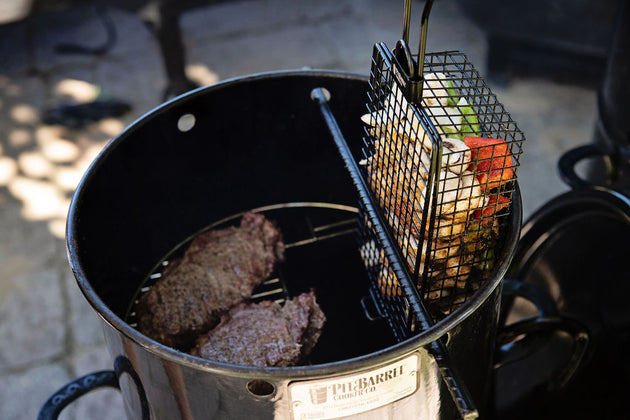
The Pit Barrel Cooker. Real charcoal burning directly beneath vertically hung meat, self-regulating to a fast 275 to 310 range. Engineered around real fire, real smoke, and real BBQ flavor.
01 / The SetupSame Brisket, Same Rub, Same Morning
We started with two USDA Choice packer briskets, both right around 12 pounds, both trimmed to the same quarter-inch fat cap, and both seasoned identically with a 50/50 salt and pepper blend. One went on a leading pellet smoker set to 250 degrees Fahrenheit. The other hung from steel hooks in an 18.5 inch Pit Barrel Cooker, which self-regulated to its standard 275 to 310 degree range. Both were started at 7 AM with the same goal: finished brisket by mid-afternoon.
02 / The ClockCook Time Results
The Pit Barrel brisket finished first by a significant margin. At 1 PM, six hours into the cook, the Pit Barrel brisket probed tender at 203 degrees and came off the cooker. The pellet smoker brisket needed an additional 4.5 hours, finally finishing at 5:30 PM at 202 degrees. Total cook time: 6 hours for the Pit Barrel, 10.5 hours for the pellet smoker. The Pit Barrel's higher cooking temperature range produced equivalent tenderness in significantly less time.
03 / The CrustBark Development
The bark difference was visible from across the kitchen. The Pit Barrel brisket had a deep, almost black bark with a uniformly developed crust on every side, the result of vertical hanging that exposed all sides to direct heat and smoke. The pellet smoker brisket had decent bark on the top surface but noticeably softer texture on the bottom where the meat had rested against the grate. The Pit Barrel produced bark that looked like it came off a competition smoker. The pellet smoker bark looked like it came off an oven.
04 / The RingSmoke Ring Comparison
Slicing into both briskets revealed a stark difference. The Pit Barrel brisket showed a deep pink smoke ring approximately a quarter inch into the meat, the kind of ring competition pitmasters chase. The pellet smoker brisket showed a faint, narrow pink line that some tasters questioned was a smoke ring at all. This is consistent with what BBQ science has demonstrated for years. Real charcoal combustion produces nitric oxide that creates the classic pink smoke ring. Pellet smokers, which use compressed sawdust fed into a heating element, produce significantly less of this compound.
05 / The TasteFlavor Evaluation
Five tasters evaluated both briskets blind, with samples identified only as A and B. All five identified the Pit Barrel brisket as having deeper, more authentic BBQ flavor. Words used to describe the Pit Barrel brisket included "smoky," "rich," "real BBQ," and "like the good Texas places." Words used to describe the pellet smoker brisket included "mild," "clean," "like an oven roast," and "good but not BBQ." Three of five tasters said they would not have identified the pellet smoker brisket as BBQ if served without context.
Three of five tasters said they would not have identified the pellet smoker brisket as BBQ if served without context.
06 / The TextureTexture And Moisture
Both briskets were tender, with no significant difference in moisture retention. The Pit Barrel's vertical hanging design self-bastes the meat as juices flow downward and fat vaporizes back up to coat the surface. The pellet smoker's water pan and lower cooking temperature also produced moist meat. This is one category where both cookers performed well, though the Pit Barrel achieved its results without a water pan or any moisture management equipment.
07 / Hands-OffEffort And Attention Required
The Pit Barrel cook required zero attention between lighting and pulling the brisket. The cooker self-regulated temperature for the entire 6-hour cook. The pellet smoker required pellet hopper refills twice during the longer cook and one controller restart after a brief temperature swing. Both technically qualify as set-it-and-forget-it, but the Pit Barrel was actually forgotten about; the pellet smoker required two interventions.
08 / The MoneyCost Analysis
Total fuel cost for the cook: approximately $4 worth of charcoal for the Pit Barrel. Approximately $8 worth of specialty pellets plus electricity for the pellet smoker. Over a year of regular BBQ cooking, the Pit Barrel costs significantly less in fuel. Add in the initial cooker price difference (the pellet smoker tested cost approximately 4 times more than the 18.5 inch Pit Barrel) and the value comparison becomes overwhelming.
Run the numbers. Cheaper fuel every single cook (about $4 of charcoal vs $8 of specialty pellets plus electricity) on a cooker that costs roughly a quarter of the pellet smoker's price. Lower upfront cost, lower running cost, and the better brisket. The value comparison isn't close.
09 / The VerdictThe Honest Verdict
The Pit Barrel Cooker produced better brisket in less time at a fraction of the cost. The pellet smoker produced acceptable brisket but with milder flavor, slower cooking, and significantly higher total ownership cost. For backyard cooks who want real BBQ that tastes like the BBQ joints they admire, the test clearly favors the drum smoker. Pellet smokers have a place for cooks who prioritize convenience and digital temperature control over flavor, but they do not produce competition-quality BBQ regardless of marketing claims to the contrary.
10 / The ScienceWhy This Matches BBQ Science
The results match what BBQ science has shown for years. Real charcoal combustion produces compounds that pellet smokers cannot replicate. Vertical hanging produces more even cooking than horizontal grates. Higher cooking temperatures in the 275 to 310 range produce better bark than lower temperatures. The Pit Barrel was engineered around these principles. Pellet smokers were engineered around convenience. Both are honest design choices, but they produce different results, and the difference matters if you care about real BBQ flavor.
Get A Real BBQ Smoker,
Not An Outdoor Convection Oven.
Real fire. Real smoke. Real BBQ.
Shop The Pit Barrel →