
Why Fast And Hot
Beats Low And Slow
For Most Backyard BBQ
Low and slow at 225 is one valid method, not the only one. For most backyard cooks, 275 to 310 degrees produces equivalent or better results in dramatically less time. The math behind it deserves a closer look.

Walk into any BBQ forum and you will hear the same mantra repeated like scripture: low and slow at 225 degrees Fahrenheit is the only true way to BBQ. The truth is more complicated. Low and slow is one valid cooking method, not the only one. For most backyard cooks, fast and hot cooking at 275 to 310 degrees Fahrenheit produces equivalent or better results in dramatically less time. The Pit Barrel Cooker is engineered around this approach, and the math behind it deserves a closer look.
01 / The OriginWhere The 225 Degree Rule Came From
Traditional BBQ cooking developed on offset smokers in Texas and the American South over the last century. Offset smokers have specific design constraints that make low and slow cooking practical. The firebox and cook chamber are separated, requiring smoke to travel some distance before reaching the meat. Maintaining higher temperatures in this design requires constant fire management. The 225 degree benchmark emerged as a temperature that offset smokers could hold reliably with manageable fire-tending. It was a practical choice, not a magic number.
Where Fast And Hot Fits In
Cheese, fish, jerky. Sub-cook temperatures, flavor only.
Traditional offset territory. 12 to 14 hour brisket cooks.
The Pit Barrel sweet spot. Same BBQ in half the time.
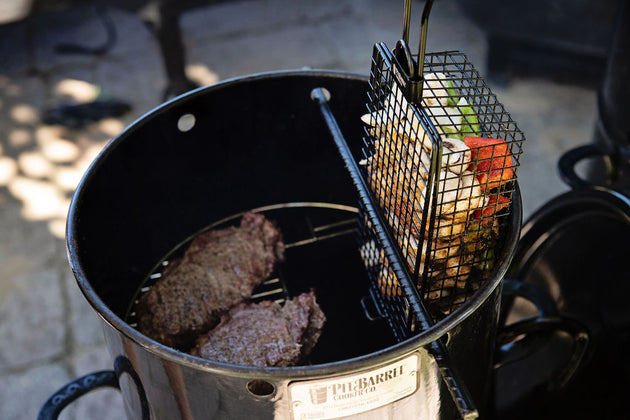
Steaks, burgers, vegetables. Hot and fast searing.
02 / The MythThe Collagen Breakdown Myth
BBQ enthusiasts often justify low and slow cooking by citing collagen breakdown. The argument goes that collagen converts to gelatin only at low temperatures over long times, producing tender BBQ. This is partly true and mostly misunderstood. Collagen breaks down at temperatures starting around 160 degrees Fahrenheit, and the breakdown accelerates at higher temperatures. The Pit Barrel's 275 to 310 degree cooking range produces complete collagen conversion in significantly less time than 225 degree cooking, with no detectable difference in tenderness in side-by-side tests.
03 / The BarkFast And Hot Produces Better Bark
Bark development is one of the most prized qualities in great BBQ. Bark forms when the surface of the meat dehydrates and the sugars in the rub caramelize, producing the dark, flavorful crust that defines competition-quality BBQ. Bark forms faster and more uniformly at higher temperatures. The Pit Barrel's 275 to 310 degree cooking produces deeper, more uniform bark than 225 degree cooking, with the vertical hanging design exposing every side of the meat to consistent heat for even bark development.

04 / The TimeCook Times That Fit Real Life
This is the practical advantage that matters most for backyard cooks. Traditional low and slow brisket takes 12 to 14 hours. Fast and hot brisket on a Pit Barrel takes 6 to 7 hours. Traditional low and slow pork shoulder takes 12 hours. Fast and hot pork shoulder takes 5 to 6. Traditional ribs take 5 to 6 hours. Fast and hot ribs take 3 to 4. The faster cook times turn BBQ from a weekend-consuming project into something you can do on a weekday evening or a weekend morning without sacrificing the entire day.
225 was a practical choice. Not a magic number.
05 / The Smoke RingBetter Smoke Ring At Higher Temperatures
Smoke rings form when nitric oxide from combustion reacts with myoglobin in the surface of the meat. The reaction stops when the meat surface reaches roughly 170 degrees Fahrenheit. At lower cooking temperatures, the meat surface takes longer to reach 170 degrees, theoretically allowing for deeper smoke rings. In practice, the Pit Barrel's real charcoal combustion produces so much more nitric oxide than pellet smokers or offset smokers running at typical temperatures that the smoke rings remain deep and uniform even with the shorter cook times. Real charcoal at fast and hot temperatures wins on smoke ring quality.
06 / The StallFast And Hot Solves The Stall
The stall is one of the most frustrating phenomena in low and slow cooking. Meat reaches an internal temperature of approximately 165 degrees Fahrenheit and stops rising for several hours, due to evaporative cooling at the meat surface. Traditional smokers fight the stall with wrapping in foil or butcher paper, often called the Texas Crutch. Fast and hot cooking pushes through the stall naturally. The higher ambient temperature provides enough heat to overcome evaporative cooling, eliminating the stall in most cases. No wrapping required, simpler cooks.
Skip the wrap. The Texas Crutch (wrapping in foil or butcher paper at the stall) is a technique developed to push low-and-slow cooks through the 165°F evaporative cooling plateau. At fast-and-hot temperatures, the ambient heat is enough to muscle through the stall without wrapping. Skipping the wrap also preserves the full bark texture that wrapping softens. Less work, better bark.
07 / The SetupLess Babysitting At Higher Temperatures
Counter intuitive but true. Low and slow cooking on traditional smokers requires constant attention because small temperature drops can cause significant time delays. Fast and hot cooking on a Pit Barrel runs in a wider temperature range (275 to 310 degrees) that is naturally easier to maintain. The cooker self-regulates within this range without intervention, producing consistent results without the constant temperature monitoring that low and slow cooking demands.
08 / The ExceptionWhen Low And Slow Still Makes Sense
Fast and hot cooking is not always the right answer. Some specific applications genuinely benefit from low and slow techniques. Cold smoking for cheese or fish requires temperatures well below BBQ cooking range. Some Texas-style brisket purists insist on 225 degree cooking for the bark texture they prefer, though side-by-side blind tasting frequently fails to distinguish their preference. Beef ribs sometimes benefit from longer cooks at lower temperatures. These applications are real but represent a small fraction of typical backyard BBQ.

09 / The DefaultWhy Fast And Hot Is The Right Default For Most Cooks
For the average backyard cook who wants to make ribs on Saturday, brisket on Sunday, pork shoulder for a family gathering, or chicken for a weeknight dinner, fast and hot cooking on a Pit Barrel produces excellent results in less time with less effort than traditional low and slow methods. The faster cook times, better bark development, deeper smoke rings, and elimination of the stall make it the practical default for most backyard BBQ applications.
10 / The CookerThe Pit Barrel Is Engineered For Fast And Hot
The Pit Barrel Cooker's design specifically optimizes for fast and hot cooking. Pre-calibrated air vents hold the cooker in the 275 to 310 degree range. The vertical hanging design takes advantage of the higher temperatures to produce uniform bark on every side. The sealed barrel construction makes temperature regulation effortless. The whole cooker is built around the same principle that competition teams have been adopting for years: fast and hot is the better way to BBQ.
Try Fast And Hot.
Get A Pit Barrel.
Pre-calibrated for the sweet spot. Engineered for the math that works.
Shop The Lineup →